How Frank Sinatra Almost Became an Action Hero
Ol' Blue Eyes nearly became one of the most beloved action stars of all time. Can you imagine him crawling through air ducts?
Did you know Hollywood almost turned Frank Sinatra into...an action star? Imagine one of the greatest action movies of all time -- an endlessly quotable, high-octane thriller with a terrific villain, fun side characters, and a gruff but lovable hero--starring Ol' Blue Eyes.
Well, it almost happened and here's how...
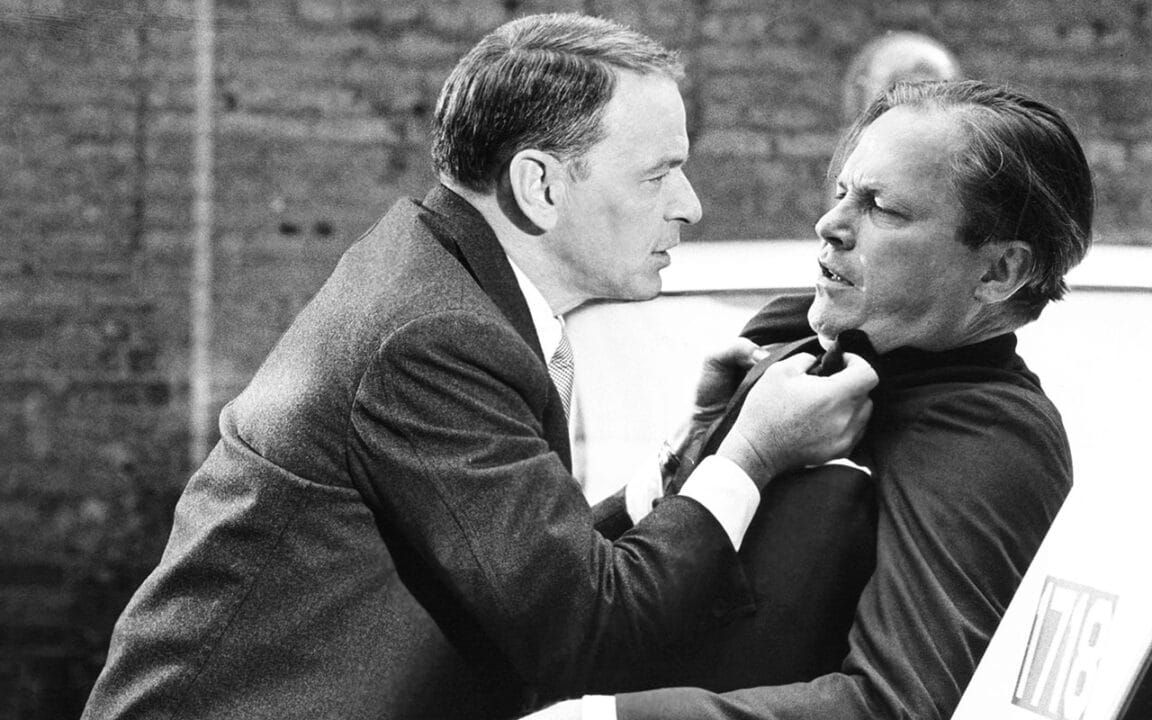
It started, as most movies do, with a novel. This one was written by author Roderick Thorp, who had created a character named Detective Joe Leland. Thorp's 1966 crime novel, The Detective, about a PI who investigates the untimely passing of a man somehow tied to his time in the military. In 1968, director Gordon Douglas and screenwriter Abby Mann brought Thorp's book to the big screen with Sinatra in the lead role.
Quite a few details are changed to fit the film paradigm, but The Detective also takes advantage of the newly repealed Hays Code by leaning into the gruesomeness of the crimes committed. Overall, it's an intense, gritty crime drama that might be one of Sinatra's best performances. It also has a great supporting cast of Jack Klugman, Jacqueline Bisset, Lee Remick, and Robert Duvall, among many others. Even a small uncredited role by Bette Midler!
So, when the film did well at the box office, it was only natural for the studio to want to pursue a sequel. Except the sequel didn't appear for another 11 years, when Thorp published his follow-up novel to the Detective, titled Nothing Lasts Forever. Producer Lloyd Levin, who had worked on films like Field of Dreams, The Rocketeer, and Boogie Nights among a number of other hit films, had the rights to Thorp's book while working for the production arm of 20th Century Fox. He hired screenwriter Jeb Stuart to adapt the story for the screen, but there were some wrinkles to iron out first.
For one, Nothing Lasts Forever was a more action-oriented story...and Sinatra was already much older by the time the book had come out. Stuart also made a slew of edits to the script--names had changed, villain motivations had shifted, audiences expected a lot more action now that films like The Terminator, Rambo, and Predator were hitting theaters...and Sinatra...was already well into his 70s.
And yet, despite the absurdity of a septugenarian crooner turning into an action star, contractually, the studio was forced to offer Sinatra the lead role. And thankfully--for all of us, but perhaps for Sinatra most of all--he said no. Apparently, he'd signed on to play Dirty Harry, but had to leave the role because he wasn't able to hold the pistol due to a hand injury, so there was no way he was going to swing through windows or climb through duct work.
You see, Thorp's book had been inspired by a showing of The Towering Inferno, the 1974 disaster film in which a San Francisco high rise is set ablaze by an electrical short. According to the story, Thorp had gone to bed that night and dreamt about a guy being chased through an office building by men with guns. When Levin pitched the project to Stuart, he gave the writer one caveat: the conceit of the story taking place in Los Angeles at Christmastime had to stay. The rest was up to him.
Stuart was going through marital problems at the time and writing the script day and night hadn't helped anything. He'd actually gotten into a fight with his wife before going on a drive one night and wound up trapped in a lane with a large refrigerator box directly in his path. It had fallen off a truck with other appliances onboard. He had no time to react and decided to just drive over it. It was empty, but he pulled over afterward to assess what had just happened and that's when it clicked: the book's story about the detective reconciling with his estranged daughter wasn't the right call for the movie. Stuart had seen his life flash before his eyes and he hadn't made up with his wife.
So he went home, apologized, and wrote 35 pages, making significant changes from the source material. Joe Leland wasn't coming to LA from New York to visit his daughter--he was seeing his estranged wife. The villain, Anton, had invaded the Klaxon building to expose the company for their dealings with a military dictatorship. Anton Gruber was changed to Hans Gruber and Klaxon was changed to Nakatomi. And Joe Leland, the barefoot New York detective who just wanted a quiet Christmas to reconcile with his wife, was changed to John...Ford. THAT was changed to John McClane, so as not to disrespect the memory of the famous director.
And that's the story of how Frank Sinatra almost starred in Die Hard.